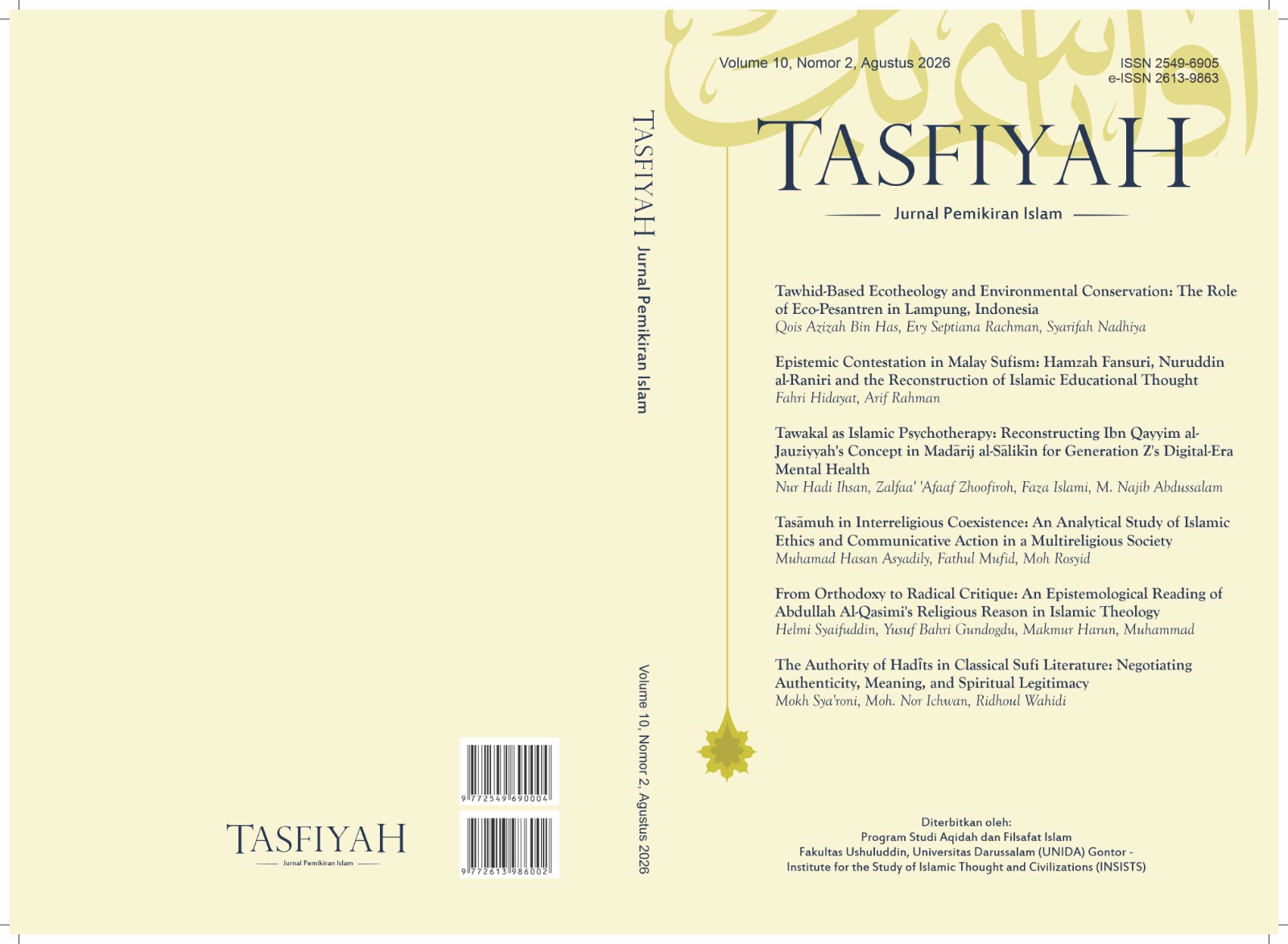
From Orthodoxy to Radical Critique: An Epistemological Reading of Abdullah Al-Qasimi’s Religious Reason in Islamic Theology
DOI:
https://doi.org/10.21111/tasfiyah.v10i2.62Keywords:
Abdullah al-Qasimi, Religious Reason, Islamic Epistemology, Dichotomous Reversal, Islamic WorldviewAbstract
This study aims to examine the transformation of Abdullah al-Qasimi’s religious reason by comparing the epistemic structures of his early, transitional, and late writings and identifying the continuities and changes underlying his intellectual trajectory. While previous studies have largely interpreted his shift from defending Salafi-Wahhabi orthodoxy to criticizing religion, tradition, Arab society, and reason as a biographical or ideological rupture, this study approaches it as a transformation of religious reason. Employing qualitative library research, intellectual history, and philosophical-theological analysis, the study comparatively examines representative primary texts through nine analytical categories: the source of truth, epistemic authority, the function of reason, the status of revelation, the conception of tawhid, the object of critique, modes of argumentation, the treatment of doubt and certainty, and the relationship between reason and transcendence. Al-Ghazali provides the diagnostic framework, while Syed Muhammad Naquib al-Attas’s Islamic Worldview serves as the evaluative horizon. The findings reveal a three-stage transformation. In the early phase, reason operates within firm doctrinal boundaries established by revelation and tawhid. In the transitional phase, inherited and mediated forms of authority become objects of critical scrutiny. In the late phase, this critical orientation extends to language, collective belief, religious representation, and reason itself. Despite these changes, an oppositional organization of truth and error persists across the three phases. This pattern is conceptualized as dichotomous reversal, in which the direction and objects of negation change without overcoming the underlying binary epistemic structure. The study therefore proposes epistemic integration as a reconstructive model that brings ʿaql, naql, ethical-spiritual formation, and tawhidic orientation into a mutually reinforcing relationship while preserving the critical function of reason.
References
Al Haidary, Abdullah Haq, Achmad Reza Hutama Al Faruqi, Abbas Shofwan MF, and Rif’at Husnul Ma’afi. “Islamic Worldview as a Basis for Islamization of Science Concept According to Syed Muhammad Naquib Al-Attas.” KALAM 18, no. 1 (2024): 19–36. https://doi.org/10.24042/002024181145700.
Al-Attas, Syed Muhammad Naquib. Prolegomena to the Metaphysics of Islam: An Exposition of the Fundamental Elements of the Worldview of Islam. International Institute of Islamic Thought and Civilization (ISTAC), 1995.
Al-Ghazali, Abu Hamid. Al-Munqidz Min al-Ḍalāl. 7th ed. Dār al-Andalus, 1967.
Al-Ghazali, Abu Hamid. Mishkāt Al-Anwār. Al-Dār al-Qawmīyah lil-Ṭibāʿah wa-l-Nashr, 1964.
Al-Ghazali, Abu Hamid. Mīzān Al-ʿAmal. Dār al-Maʿārif, 1964.
Al-Qasimi, Abdullah. Al-Burūq al-Najdiyyah Fī Iktisāḥ al-Ẓulumāt al-Dajwiyyah. Vol. 1. Maṭbaʿat al-Manār, 1931.
Al-Qasimi, Abdullah. Al-Faṣl al-Ḥāsim Bayn al-Wahhābiyyīn Wa Mukhālifīhim. Maṭbaʿat al-Taḍāmun al-Akhawī, 1934.
Al-Qasimi, Abdullah. Al-Ṣirāʿ Bayn al-Islām Wa al-Wathaniyyah. Vol. 1. Al-Maṭbaʿah al-Salafīyah, 1937.
Al-Qasimi, Abdullah. Al-ʿArab Ẓāhirah Ṣawtiyyah. Maṭābiʿ Montmartre, 1977.
Al-Qasimi, Abdullah. Ayyuhā Al-ʿAql Man Raʾāk. 2nd ed. Dār al-Ghad, 1967.
Al-Qasimi, Abdullah. Hādzī Hiya Al-Aghlāl. Maṭbaʿat Miṣr Sharikat Musāhamah Miṣrīyah, 1946.
Al-Qasimi, Abdullah. Yakdzibūn Kay Yaraw Al-Ilāh Jamīlan. 2nd ed. Dār al-Kātib al-ʿArabī, 2001.
Arkoun, Mohammed. Rethinking Islam: Common Questions, Uncommon Answers. Westview Press, 1994.
Bin Adi, Yusuf. “ʿAbdullah Al-Qasimi: Min al-Mudāfaʿah al-Īdiyūlūjiyyah Ilā al-Tafkīr Bi-l-Miʾwal al-Haddām.” In Al-Falsafah al-ʿArabiyyah al-Muʿāṣirah: Taḥawwulāt al-Khiṭāb Min al-Jumūd al-Tārīkhī Ilā Maʾziq al-Thaqāfah Wa al-Īdiyūlūjiyā, edited by Ismail Mahnanah. Dār al-Amān, 2014.
Commins, David. The Wahhabi Mission and Saudi Arabia. I.B. Tauris, 2006.
DeLong-Bas, Natana J. Wahhabi Islam: From Revival and Reform to Global Jihad. Oxford University Press, 2004.
Elsässer, Sebastian. “A Wave of Unbelief? Conservative Muslims and the Challenge of Ilḥād in the Post-2013 Arab World.” Religions 16, no. 6 (2025): 670. https://doi.org/10.3390/rel16060670.
Fanani, Ahmad Farid, Rifat Syauqi Efendi, and Shofiyullah Muzammil. “Tazkiyah Al-Nafs in Al-Ghazali’s Thought: A Sufi Framework for Enhancing Mental Resilience among Generation-Z.” Tasfiyah: Jurnal Pemikiran Islam 10, no. 1 (2026): 77–116. https://doi.org/10.21111/tasfiyah.v10i1.4.
Hidayatullah, Elit Ave, and Syamsuddin Arif. “Syed Muhammad Naquib Al-Attas’ Exposition on the Concept of Ethics.” Jurnal Akidah & Pemikiran Islam 24, no. 1 (2022): 409–46. https://doi.org/10.22452/afkar.vol24no1.12.
Hourani, Albert. Arabic Thought in the Liberal Age, 1798–1939. Cambridge University Press, 1983.
LaCapra, Dominick. Rethinking Intellectual History: Texts, Contexts, Language. Cornell University Press, 1983.
Lincoln, Yvonna S., and Egon G. Guba. Naturalistic Inquiry. SAGE, 1985.
Miles, Matthew B., A. Michael Huberman, and Johnny Saldaña. Qualitative Data Analysis: A Methods Sourcebook. 4th ed. SAGE, 2020.
Mohamed, Nabil Yasien. Ghazālī’s Epistemology: A Critical Study of Doubt and Certainty. Routledge, 2024.
Muslim, Adi Abdullah, Said Agil Husin Al Munawar, Iik Arifin Mansurnoor, and Asmawi. “Religious Authority in Islam: Between Classical Fiqh and Hadith Traditions in Contemporary Epistemological Discourse.” Tasfiyah: Jurnal Pemikiran Islam 10, no. 1 (2026): 211–51. https://doi.org/10.21111/tasfiyah.v10i1.32.
Saldaña, Johnny. The Coding Manual for Qualitative Researchers. 4th ed. SAGE, 2021.
Skinner, Quentin. Visions of Politics. Vol. 1. Regarding Method. Cambridge University Press, 2002.
Syafaq, Hammis, Masdar Hilmy, Nur Lailatul Musyafaah, and Mohammed Ramadhan Abraheem Alshaykh Ali. “Reconstructing Islamic Epistemology: Bridging Metaphysics, Reason, and Revelation.” Teosofi: Jurnal Tasawuf Dan Pemikiran Islam 14, no. 2 (2024): 240–69. https://doi.org/10.15642/teosofi.2024.14.2.240-269.
Taşkın, Zeyneb Betül. “Skepticism in Al-Ghazālī and Descartes: A Reply to Sami M. Najm.” Ankara Üniversitesi İlahiyat Fakültesi Dergisi 65, no. 2 (2024): 583–97. https://doi.org/10.33227/auifd.1258110.
Tracy, Sarah J. “Qualitative Quality: Eight ‘Big-Tent’ Criteria for Excellent Qualitative Research.” Qualitative Inquiry 16, no. 10 (2010): 837–51. https://doi.org/10.1177/1077800410383121.
Wasella, Jürgen. Min Uṣūlī Ilā Mulḥid: Qiṣṣat Inshiqāq ʿAbd Allāh al-Qasīmī. Dār al-Kunūz al-Adabiyyah, 2001.
Yahya, Yuangga Kurnia, and Umi Mahmudah. “State Religious Policies and the Emergence of Atheism in Saudi Arabia, 2000–2022.” Center of Middle Eastern Studies (CMES) 19, no. 1 (2026): 1–14. https://doi.org/10.20961/cmes.19.1.115151.
Downloads
Submitted
Accepted
Published
How to Cite
Issue
Section
License
Copyright (c) 2026 Tasfiyah: Jurnal Pemikiran Islam

This work is licensed under a Creative Commons Attribution-NonCommercial-ShareAlike 4.0 International License.