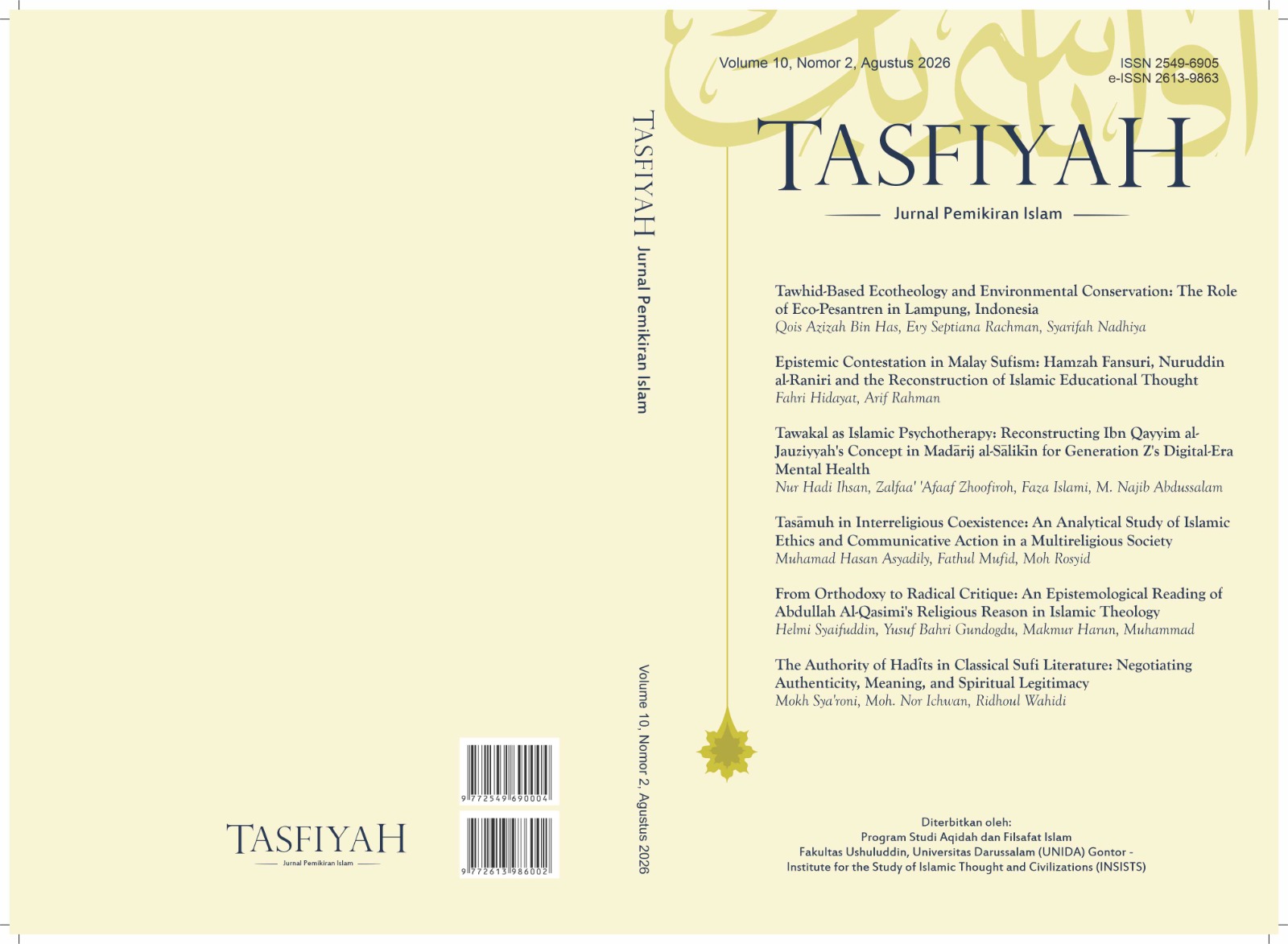
Epistemic Contestation in Malay Sufism: Hamzah Fansuri, Nuruddin al-Raniri and the Reconstruction of Islamic Educational Thought
DOI:
https://doi.org/10.21111/tasfiyah.v10i2.54Keywords:
Hamzah Fansuri, Nuruddin al-Raniri, Epistemic Contestation, Malay Sufism, Islamic Educational EpistemologyAbstract
This article examines the intellectual debate between Hamzah Fansuri and Nuruddin al-Raniri as a form of epistemological contestation within the Malay Sufi tradition. The study aims to explain how these two figures represented different models of Islamic knowledge validation and how their ideas remain relevant to reconstructing contemporary Islamic education. Hamzah Fansuri, in particular, represents an ontological-transformative epistemology. In contrast, Nuruddin al-Raniri represents a normative-theological epistemology. This study employs a qualitative library research approach using intellectual history and epistemological analysis of Hamzah Fansuri’s works, al-Raniri’s polemics, and contemporary Islamic educational thought. The findings reveal that the debate between Hamzah and al-Raniri constituted a struggle over epistemic authority concerning the sources and validity of Islamic knowledge in the Malay world. Furthermore, the article finds that the crisis of modern Islamic education is characterized by the fragmentation between spirituality, ethics, and intellectuality. Therefore, this article proposes the concept of an integrative Islamic epistemology of education as a synthesis of spiritual, ethical, and rational dimensions in the formation of the ideal human being grounded in adab, revelation, and spiritual transformation.
References
Abdusshomad, Alwazir, Benny Kurnianto, and Nawang Kalbuana. “Between Memorization and Critical-Transformative Pedagogy: Translating Islamic Religious Education Reform in Indonesia and Malaysia.” J-PAI: Jurnal Pendidikan Agama Islam 12, no. 2 (2026). https://doi.org/10.18860/jpai.v12i2.41966.
Ahmed, Farah, and Safaruk Chowdhury. “Rethinking Contemporary Schooling in Muslim Contexts: An Islamic Conceptual Framework for Reconstructing K-12 Education.” Educational Philosophy and Theory 57, no. 2 (2025): 152–65. https://doi.org/10.1080/00131857.2024.2411325.
Al-Attas, Syed Muhammad Naquib. A Commentary on the Ḥujjat Al-Ṣiddīq of Nūr al-Dīn al-Rānīrī. Ministry of Culture, Malaysia, 1986.
Amnan, Dzulkifli Hadi Imawan. “Shaykh Nuruddin Ar-Raniry’s Contribution in His As-Shirath al-Mustaqim to Popularizing Islamic Law in the Nusantara.” Journal of Islamic Thought and Civilization 12, no. 1 (2022): 270–81. https://doi.org/10.32350/jitc.121.16.
Arfan, Arfan, As’ad As’ad, Edi Kurniawan, Massuhartono Massuhartono, Ghina Nabilah Efendi, and Mukhlas Nugraha. “Orthodoxy and Heresy in the Thought of Nūr Al-Dīn al-Rānīrī: Shaṭaḥāt, Takfīr, and the Boundaries of Shariah.” Justicia Islamica 22, no. 2 (2025): 327–56. https://doi.org/10.21154/justicia.v22i2.10808.
Ateng Ruhendi, Afnie Rizky Nurkamaliyah, Nirwati, Nenden Ahadiah Halimah, Izzudin, and Reza Fauzi Nazar. “A Spiritual-Cognitive Framework for Islamic Religious Education through the Integration of Al-Ghazali’s Concepts of Kasbi and Laduni Knowledge.” EDUKASI: Jurnal Penelitian Pendidikan Agama Dan Keagamaan 24, no. 1 (2026): 150–62. https://doi.org/10.32729/edukasi.v24i1.2429.
Attas, Syed Muhammad Naquib al-. Islam and Secularism. ABIM, 1978.
Attas, Syed Muhammad Naquib al-. “New Light on the Life of Hamzah Fansuri.” Journal of the Malaysian Branch of the Royal Asiatic Society 40, no. 1 (1967). https://www.jstor.org/stable/41419005.
Attas, Syed Muhammad Naquib al-. The Mysticism of Hamzah Fansuri. University of Malaya Press, 1970.
Aulia, Selena, Syahidin Syahidin, and Agus Fakhruddin. “The Influence of the Islamic Education Curriculum on Reducing Epistemological Fragmentation and Synthesizing the Islamic Weltanschauung Amid the Dichotomy of Knowledge.” Adabuna: Jurnal Pendidikan Dan Pemikiran 5, no. 2 (2026): 144–63. https://doi.org/10.38073/adabuna.v5i2.4706.
Azizah, Lailiyatul, and Norhayati Hamzah. “Bustān Al-Salāṭīn: Representation of Malay Islamic Civilization (Aceh) in the 17th Century.” Journal of Islamic Civilization 4, no. 1 (2022): 24–37. https://doi.org/10.33086/jic.v4i1.2940.
Beaney, Michael, and Karyn Lai. “Towards a Deep Epistemology: Knowing in Historical and Cross-Cultural Context.” British Journal for the History of Philosophy 33, no. 6 (2025): 1313–59. https://doi.org/10.1080/09608788.2025.2578821.
Braginsky, V. Y. “Some Remarks on the Structure of the ‘Sya’ir Perahu’by Hamzah Fansuri.” Bijdragen Tot de Taal-, Land- En Volkenkunde / Journal of the Humanities and Social Sciences of Southeast Asia 131, no. 4 (1975): 407–26. https://doi.org/10.1163/22134379-90002659.
Burhanudin, Jajat. “Islamic Turn in Malay Historiography: Bustān al-Salāṭīn of 17th Century Aceh.” Studia Islamika 28, no. 3 (2021): 579–605. https://doi.org/10.36712/sdi.v28i3.21259.
Chen, Ming-Kuo, and Yi-Huang Shih. “The Implications of Nel Noddings’ Ethics of Care for Fostering Teacher-Student Relationships in Higher Education.” Frontiers in Education 10 (July 2025): 1602786. https://doi.org/10.3389/feduc.2025.1602786.
Chowdury, Saeyd Rashed Hasan. “Sufism In Contemporary Contexts: Spirituality, Subjectivity, and the Limits of Modern Rationality.” MIQOT: Jurnal Ilmu-Ilmu Keislaman 50, no. 1 (2026): 1. https://doi.org/10.30821/miqot.v50i1.1566.
Drewes, G. W. J. “De herkomst van Nuruddin ar-Raniri.” Bijdragen tot de Taal-, Land- en Volkenkunde 111, no. 2 (1955): 137–51. https://doi.org/10.1163/22134379-90002351.
Drewes, G. W. J. “Sjamsuddins onvindbare Sjarh Ruba’i Hamza al-Fansuri.” Bijdragen tot de taal-, land- en volkenkunde / Journal of the Humanities and Social Sciences of Southeast Asia 107, no. 1 (1951): 31–41. https://doi.org/10.1163/22134379-90002466.
Drewes, G. W. J., L. F. Brakel, and A. H. Johns. “Review: The Poems of Hamzah Fansuri.” Bijdragen Tot de Taal-, Land- En Volkenkunde 146, no. 2/3 (1990). https://www.jstor.org/stable/27864125.
Fakhury, Ahmad Nazar, Nina Amelia, Fenia Marliana, et al. “Reconstructing Islamic Religious Education Curriculum through Qur’anic Values and Epistemology.” Al-Fahmu: Jurnal Ilmu Al-Qur’an Dan Tafsir 5, no. 1 (2026): 1–11. https://doi.org/10.58363/alfahmu.v5i1.744.
Fansuri, Hamzah. “Asrāru’l-ʿĀrifīn fī Bayān ʿIlm al-Sulūk wa’l-Tawḥīd.” Transcription Cod. Or. 7291 (1). Leiden University Libraries, n.d. Cod. Or. 7291 (1). Leiden University Libraries.
Fansuri, Hamzah. “Naskah Syair Perahu Hamzah Fansuri Pasaman Sumatera Barat.” Pasaman, Sumatera Barat, n.d. Internet Archive. https://archive.org/details/NaskahSyairPerahuHamzahFansuriPasamanSumateraBarat/page/n1/mode/2up.
Fauji, Ikang, and Mulyawan Safwandy Nugraha. “Redefining Epistemology: Exploring a New Paradigma in Islamic Education Research.” Indonesian Journal of Multidiciplinary Research 4, no. 2 (2024): 485–90. https://doi.org/10.17509/ijomr.v4i2.80236.
Ibn ʿArabī, Muḥyī al-Dīn. Fuṣūṣ Al-Ḥikam. Intishārāt al-Zahrāʾ, 1987.
Ito, Takeshi. “Why Did Nuruddin Ar-Raniri Leave Aceh in 1054 A.H.?” Bijdragen Tot de Taal-, Land- En Volkenkunde 134, no. 4 (1978). https://www.jstor.org/stable/27863207.
Jenuri, Achmad Faqihuddin, Edi Suresman, Mulyana Abdullah, and Fahrudin. “Overcoming the Spiritual Emptiness of Students in the Modern Era through the Integration of Al-Ghazali’s Human Concepts in the Islamic Religious Education Learning Model.” Cogent Education 12, no. 1 (2025): 2497147. https://doi.org/10.1080/2331186X.2025.2497147.
Jīlī, ʿAbd al-Karīm al-. Al-Insān al-Kāmil Fī Maʿrifat al-Awākhir Wa al-Awāʾil. Dār al-Kutub al-ʿIlmiyyah, 1997.
Kosim, Mohammad, Faqihul Muqoddam, Faidol Mubarok, and Nur Quma Laila. “The Dynamics of Islamic Education Policies in Indonesia.” Cogent Education 10, no. 1 (2023): 2172930. https://doi.org/10.1080/2331186X.2023.2172930.
Meyer, Verena. “History in Motion Nūr Al-Dīn al-Rānīrī’s Retelling of ʿAbbāsid History in Seventeenth-Century Aceh.” Afkaruna: Indonesian Interdisciplinary Journal of Islamic Studies 20, no. 2 (2024). https://doi.org/10.18196/afkaruna.v20i2.24794.
Miswari, Miswari, Abdul Aziz Dahlan, and Abdul Hadi W.M. “Ḥamzah Fanṣūrī’s Contextual Analogies: Wujūdiyya Teaching in Malay 16th Century.” Teosofia: Indonesian Journal of Islamic Mysticism 11, no. 1 (2022): 103–22. https://doi.org/10.21580/tos.v11i1.11243.
Mitova, Veli. “De-Idealising Epistemology Through Collectivising*.” International Journal of Philosophical Studies 33, no. 2 (2025): 183–205. https://doi.org/10.1080/09672559.2025.2482906.
Nasir, Mohamad Nasrin. “A Study of the Reinterpretation of the Qur’an in a Seventeenth-Century Malay Sufi Text Written by al-Rānīrī.” Islamic Studies 62, no. 4 (2023): 453–69. https://doi.org/10.52541/isiri.v62i4.2659.
Nayab, Syeda Dur e, and Md. Mahdi Hassan. “The Concept of the Perfect Human (al-Insān al-Kāmil) in Ibn Arabi’s Thought.” Aqlania: Jurnal Filsafat Dan Teologi Islam 16, no. 1 (2026). https://doi.org/https://doi.org/10.32678/aqlania.v16i1.21.
Ngadiran, Siti Nor Aisyah, and Khalina Mohammed Khalili. “Syed Muhammad Naquib Al-Attas’s Perspective on the Interpretation of Islamic Historical Sources in the Malay World.” Journal of Al-Tamaddun 21, no. 1 (2026): 1–16. https://doi.org/10.22452/JAT.vol21no1.1.
Nieuwenhuijze, Van. “Nur Al-Din Al-Raniri als Bestrijder der Wugudiya.” Bijdragen tot de Taal-, Land- en Volkenkunde 104, no. 1 (1948): 337–411. https://doi.org/10.1163/22134379-90002528.
Nurzamsinar, Sudirman, and Abd. Wahid. “Reconstruction of Integrative Islamic Epistemology: Analysis of the Implementation of Yani, Irfani, Burhani, and Illumination.” Al-Mudarris (Jurnal Ilmiah Pendidikan Islam) 9, no. 2 (2026): 431–46. https://doi.org/10.23971/mdr.v9i2.11433.
Pritchard, Duncan. “Extended Virtue Epistemology.” Inquiry 61, nos. 5–6 (2018): 632–47. https://doi.org/10.1080/0020174X.2017.1355842.
Research Scholar, Department of Education, Sidho-Kanho-Birsha University, Purulia, West Bengal, India, Shankar Mondal, Sudeb Ghosh, and Research Scholar, Department of Education, Sidho-Kanho-Birsha University, Purulia, West Bengal, India & Assistant Professor in Philosophy, Institute of Education (PG) for Women, Chandennagore, Hooghly, West Bengal, India. “Revisiting The Pedagogical Aspects Of Nel Noddings: A Critical Study.” The Social Science Review A Multidisciplinary Journal 3, no. 1 (2025). https://doi.org/10.70096/tssr.250301009.
Riswadi, Riswadi, Zen Amrullah, Wahdatun Nisa, Mubarak Mubarak, and Muhammad Sali. “Beyond Memorization: Transforming Islamic Religious Education through Deep Learning in Indonesian Border-Area Schools.” EDURELIGIA: Jurnal Pendidikan Agama Islam 9, no. 3 (2025): 290–306. https://doi.org/10.33650/edureligia.v9i3.11628.
Rizal, Muhammad, Muhammad Hidayat Ginanjar, Abdul Kodir Nurhasan, and Rifan Dainuri. “Insan Kamil-Oriented Islamic Higher Education in Society 5.0: A Systematic Literature Review of Digital Transformation, Curriculum Integration, and Value-Based Islamic Leadership.” Jurnal Pendidikan Islam 14, no. 2 (2025): 357–75. https://doi.org/doi.org/10.14421/jpi.2025.142.357-%20375.
Sahin, Abdullah. “Critical Issues in Islamic Education Studies: Rethinking Islamic and Western Liberal Secular Values of Education.” Religions 9, no. 11 (2018): 335. https://doi.org/10.3390/rel9110335.
Sangidu, Eva Farhah, Imam Wicaksono, and Shawy Shawy Ahmed Abdurrahem. “Revisiting Wujudiyyah and the Politics of Religious Orthodoxy in the Seventeenth-Century Aceh Sultanate.” Al-Adabiya: Jurnal Kebudayaan Dan Keagamaan 21, no. 1 (2026): 1–24. https://doi.org/10.37680/adabiya.v21i1.7949.
Syahrul, Muzakkir, and Ziaulhaq Hidayat. “New Face of Contemporary Sufism in Southeast Asia: Experience of Indonesia and Malaysia.” Teosofi: Jurnal Tasawuf Dan Pemikiran Islam 11, no. 2 (2021): 270–92. https://doi.org/10.15642/teosofi.2021.11.2.270-292.
Tee, Boon Chuan. “The Malay Epistemological Background in the Islamic Writings of Hamzah Fansūrī.” Al-Shajarah 29, no. 1 (2024): 153–79. https://doi.org/10.31436/shajarah.v29i1.1833.
Ulfat, Fahimah, and Farid Suleiman. “The Absent Canon: Islamic Philosophy as a Missing Dimension in Religious and Ethics Education – a Perspective from the German School Context.” British Journal of Religious Education, 2025, 1–12. https://doi.org/10.1080/01416200.2025.2610257.
Vakily, Abdollah. “Sufism, Power Politics, and Reform: Al-Rānīrī’s Opposition to Hamzah al-Fanṣūrī’s Teachings Reconsidered.” Studia Islamika: Indonesia Journal for Islamic Studies 4, no. 1 (1997): 113–35. https://doi.org/10.15408/sdi.v4i1.788.
Voorhoeve, P. “Van en over Nuruddin ar-Raniri.” Bijdragen tot de taal-, land- en volkenkunde / Journal of the Humanities and Social Sciences of Southeast Asia 107, no. 4 (1951): 353–68. https://doi.org/10.1163/22134379-90002452.
Wormser, Paul. “The Religious Debates of Aceh in the Sixteenth and Seventeenth Century: An Invisible Cultural Dialogue?” Journal of the Economic and Social History of the Orient 55, no. 2/3 (2012). https://doi.org/10.1163/15685209-12341239.
Yahya, Farouk, and Russell Jones. “Malay Manuscripts: A Guide to Paper and Watermarks. The Collected Works of Russell Jones 1972–2015.” Indonesia and the Malay World 49, no. 144 (2021): 139–394. https://doi.org/10.1080/13639811.2021.1939521.
Zekrgoo, Amir H. “The Confused Whale of the China Sea: Water Symbolism in the Works of Hamzah Fansuri.” Al-Shajarah 29, no. 1 (2024): 79–98. https://doi.org/10.31436/shajarah.v29i1.1828.
Downloads
Submitted
Accepted
Published
How to Cite
Issue
Section
License
Copyright (c) 2026 Tasfiyah: Jurnal Pemikiran Islam

This work is licensed under a Creative Commons Attribution-NonCommercial-ShareAlike 4.0 International License.