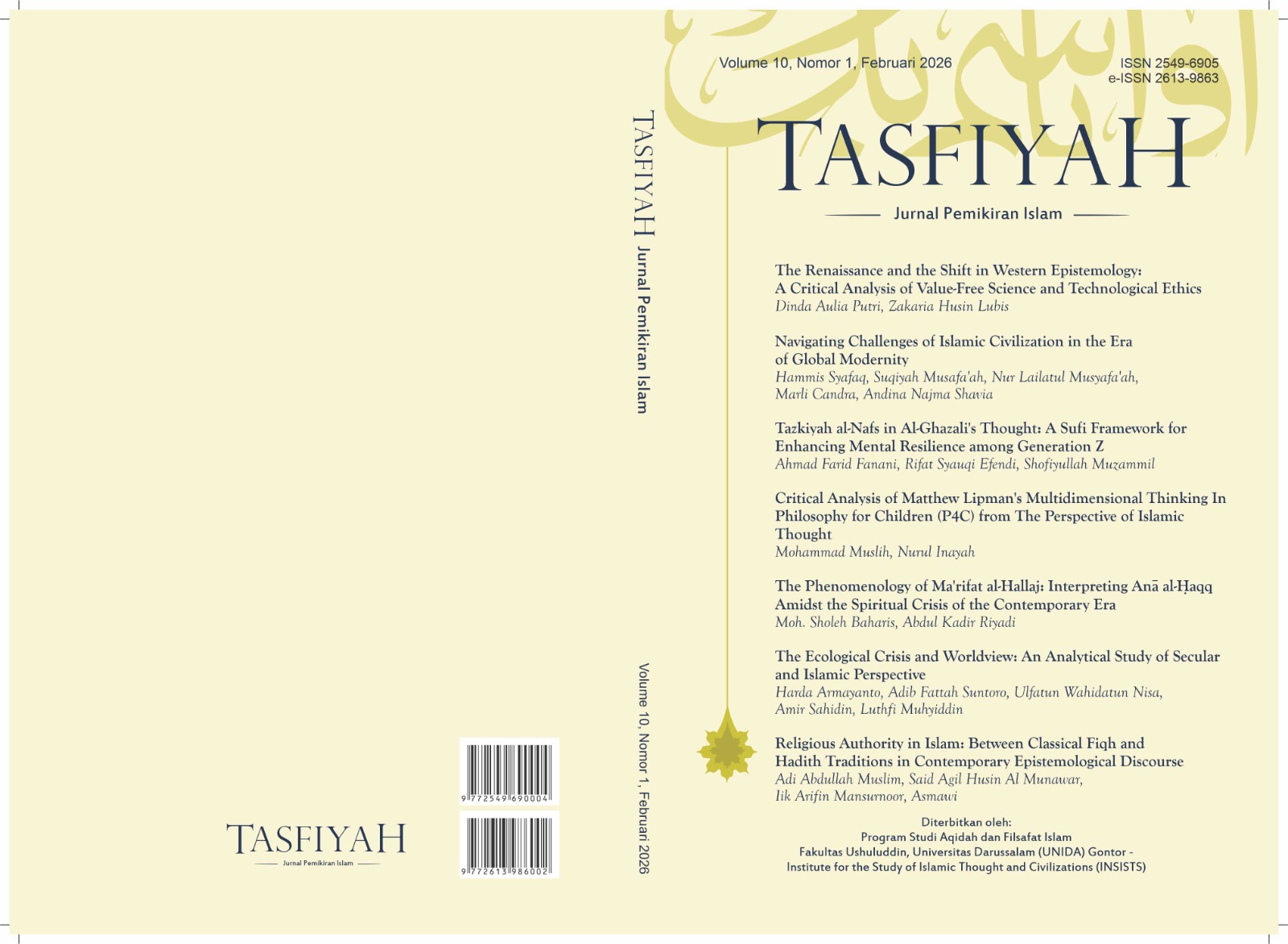
Tazkiyah al-Nafs in Al-Ghazali’s Thought: A Sufi Framework for Enhancing Mental Resilience among Generation-Z
DOI:
https://doi.org/10.21111/tasfiyah.v10i1.4Keywords:
Tazkiyatuh al-Nafs, Generation Z, Mental Health, Islamic Psychology, Imam Al-GhazaliAbstract
Generation Z, often referred to as the “Strawberry Generation,” is characterized by marked psychological vulnerability arising from social pressures and intensive digital exposure. This condition requires an approach that is not only technical but also spiritual, such as the concept of tazkiyah al-nafs in Islamic teachings. Accordingly, this study aims to analyze the potential of tazkiyah al-nafs as a mental resilience strategy for Generation Z based on al-Ghazali’s thought. This research employs a qualitative approach using the library research method with content analysis techniques. The data sources include Ihya’ ‘Ulum al-Dīn, scientific articles, and thematic books related to tazkiyah al-nafs and mental health. The findings indicate that tazkiyah al-nafs provides a systematic spiritual framework for cultivating mental resilience. The stage of takhallī teaches the release of blameworthy traits such as anger, envy, and worldly attachment, which often constitute the roots of emotional instability. Taḥallī instills virtues such as patience, gratitude, trust in God, and humility, which strengthen psychological stability and foster a sense of life meaning. Meanwhile, tajallī represents a phase of spiritual illumination in which individuals attain inner peace and profound transcendental awareness. Collectively, these three stages enhance coping capacity and establish a holistic structure of long-term resilience. This study contributes to integrating Sufi values into the framework of modern Islamic psychology while expanding the discourse on spiritual interventions as concrete solutions to mental health challenges among young generations.
References
Adedeji, Adekunle, Carlotta Langel, Amelie Feick, Martha-Sofia Borges Greibaum, Maryam Rahimi, and Saskia Hanft-Robert. “Work-Life Balance and Mental Health Outcomes for Generation Z in Germany.” Journal of Occupational & Environmental Medicine 65, no. 12 (December 2023): 987–91. https://doi.org/10.1097/JOM.0000000000002934.
Agatha, Cindy Monika. “Hubungan Adiksi Game Online Dengan Kesehatan Mental.” Universitas Pelita Harapan, 2020.
Akbar, Bintang Mukhammad Burhanudin, Dini Rahma Dwi Prawesti, and Wikan Swadesi Arum Perbani. “Big Picture Mental Health of Generation Z in The World.” Jurnal Kesehatan Komunitas Indonesia 4, no. 1 (April 2024): 1–20. https://doi.org/10.58545/jkki.v4i1.223.
Al-Ghazali, Abu Hamid Muhammad Ibn Muhammad. Iḥyā’ Ulūm Al-Dīn. Edited by Zainuddin Abi al-Fadhl Al-’Iraqiy. 1st ed. Beirut-Lebanon: Dār Ibn Hazm, 2005.
———. Kīmīyā’ Al-Sa’ādah. Cairo: Maktabat al-Qur’an, 1987.
———. Kitāb al-Arba’īn fī Uṣūl al-Dīn. Cairo: al-Istiqama, 1920.
———. Kitāb Mīzān al-ʻAmal. Beirut: Dar al-Kitab al-’Arabi, 1979.
———. Ma’ārij Al-Quds Fī Madārij Ma’rifah Al-Nafs. 2nd ed. Beirut-Lebanon: Dar al-Afaq al-Hadidah, 1988.
Alahri, Mehdi Bazi, Amir Sam Kianimoghadam, Maryam Khesali, Maryam Bakhtiari, and Samira Farahani Alavi. “The Protective Factor of Depression and Anxiety in the General Population in the Postcoronavirus Era: Coping, Spiritual Well-Being & Resilience.” Medical Science 17, no. 139 (September 2023): 1–10. https://doi.org/10.54905/disssi.v27i139.e351ms3220.
Alifuddin, Muhammad, Mahrudin Mahrudin, Rosmini Rosmini, La Ode Anhusadar, and Finsa Adhi Pratama. “Fiqh Kankilo and the Purification System of the Butonese People: A Socio-Legal Historical Perspective of Islamic Law and Legal Pluralism.” Samarah: Jurnal Hukum Keluarga Dan Hukum Islam 8, no. 2 (July 2024): 1165. https://doi.org/10.22373/sjhk.v8i2.21578.
Alsabaani, Abdullah, Abdullah Ali Alshahrani, and Abdullah Saeed Abukaftah. “Association between Over-Use of Social Media and Depression among Medical Students, King Khalid University, Kingdom of Saudi Arabia.” The Egyptian Journal of Hospital Medicine 70, no. 8 (January 2018): 1305–11. https://doi.org/10.12816/0044639.
Amhar, Nur Fajrah Azari, Nisya Fadilla, Sabrina Rizky Amelia, Nabila Sabrina Nurfianti, Rafa Aurelia, Angela Gracia Lusiani Dahut, and Nidya Malica Permata. “Dukungan Sosial Sebagai Determinan Kesehatan Mental Pada Remaja Dengan Keluarga Broken Home.” Journal of Communication and Social Sciences 1, no. 1 (June 2023): 25–36. https://doi.org/10.61994/jcss.v1i1.135.
Apriyansyah, Chandra, Sri Sukatmi, and Lily Muliana Mustafa. “Mitigating Strawberry Generation Risks Through Multiple Learning Strategies in Kindergarten.” Child Education Journal 5, no. 2 (November 2023): 120–32. https://doi.org/10.33086/cej.v5i2.4345.
Boyden, Gerri-Lyn, Maryellen D. Brisbois, Marni B. Kellogg, and Karen J. Foli. “Understanding Resilience Among Generation Z Baccalaureate Nursing Students: A Hermeneutical Phenomenology Study.” Journal of Nursing Education 63, no. 7 (July 2024): 460–69. https://doi.org/10.3928/01484834-20240505-02.
Cartwright-Stroupe, Lya M., and Jean Shinners. “Moving Forward Together: What Hope, Efficacy, Optimism, and Resilience Tell Us About Generation Z.” The Journal of Continuing Education in Nursing 52, no. 4 (April 2021): 160–62. https://doi.org/10.3928/00220124-20210315-02.
Casewit, Yousef. “Al-Ghazālī’s Virtue Ethical Theory of the Divine Names: The Theological Underpinnings of the Doctrine of Takhalluq in Al-Maqṣad Al-Asnā.” Journal of Islamic Ethics 4, no. 1–2 (December 2020): 155–200. https://doi.org/10.1163/24685542-12340042.
Chen, Jingying, Yidan Liu, Jian Dai, and Chengliang Wang. “Development and Status of Moral Education Research: Visual Analysis Based on Knowledge Graph.” Frontiers in Psychology 13 (January 2023): 1079955. https://doi.org/10.3389/fpsyg.2022.1079955.
Cheng, Su-Fen. “Application of Creative Teaching.” Hu Li Za Zhi The Journal of Nursing 65, no. 6 (December 2018): 4. https://doi.org/10.6224/JN.201812_65(6).01.
Dikeç, Gül, Simge Öztürk, Neslihan Taşbaşı, Damla Figenergül, and Bilal Buğrahan Güler. “The Perceptions of Generation Z University Students about Their Futures: A Qualitative Study.” Sci 5, no. 4 (December 2023): 45. https://doi.org/10.3390/sci5040045.
Faruqi, Achmad Reza Hutama Al, Imam Fuadi, and Ilham Dwitama Haeba. “Tazkiyah Al-Nafs Sebagai Terapi Penyakit Jiwa (Tinjauan Hadis).” Kalimah: Jurnal Studi Agama Dan Pemikiran Islam 22, no. 1 (2024): 95–120. https://doi.org/10.21111/klm.v22i1.12409.
Flynn, Deborah, and Stuart Barker. “Comparison of First-Year Nursing Students’ GAD-7 Scores: A Pilot Study Focusing on Generation Z.” British Journal of Nursing 33, no. 12 (June 2024): 546–51. https://doi.org/10.12968/bjon.2023.0080.
Ghofar, Abdul, Usman Abubakar, and Muhammad Azhar. “Tazkiyatun Nafs as A Strength Base of Teacher Personality Competency.” IJISH (International Journal of Islamic Studies and Humanities) 1, no. 2 (October 2018): 128–40. https://doi.org/10.26555/ijish.v1i2.559.
Gomes, Catarina, Isabel Duarte, Nazaré Soares Marques, and Luís Cunha. “Practical Recommendations for a Post COVID-19 Resilient Generation Z Workforce.” Human Systems Management 42, no. 1 (January 2023): 105–11. https://doi.org/10.3233/HSM-220050.
Gunawan, Muhamad Rachmat, Yona Voria Janesia, James Tampubolon, Adhy Kurniawan Mulato, and Widi Asmoro. “Enhancing Gen-Z Resilience Against Narcotics and Drugs Influence Among Smart Cities in Indonesia.” In 2024 International Conference on ICT for Smart Society (ICISS), 1–7. IEEE, 2024. https://doi.org/10.1109/ICISS62896.2024.10751012.
Han, Peng, Yingying Sun, Huifeng Chen, Yue Liu, Shuyang Liu, Jing Wang, Chunwei Chi, et al. “The Early Career Resilience Experience of Generation Z Newly Graduated Registered Nurses in Standardized Training in the Emergency Department: A Qualitative Study in Shanghai.” BMC Nursing 23, no. 1 (June 2024): 391. https://doi.org/10.1186/s12912-024-02043-3.
Hanifah Insani, Nur, Erna Andriyanti, and Endang Nurhayati. “Exploring Javanese Female Sufism In Serat Murtasiyah: A Study of Women’s Representation of Religious Values In The Domestic Realm Within Modern Western Contexts.” Hamdard Islamicus 47, no. 2 (June 30, 2024): 89–115. https://doi.org/10.57144/hi.v47i2.707.
Harari, Tali Te’eni, Yaron Sela, and Liad Bareket-Bojmel. “Gen Z during the COVID-19 Crisis: A Comparative Analysis of the Differences between Gen Z and Gen X in Resilience, Values and Attitudes.” Current Psychology 42, no. 28 (October 2023): 24223–32. https://doi.org/10.1007/s12144-022-03501-4.
Harefa, Juli Tri Vemina, Kesya Anggita Manik, Zefanya Liliana Habehan, Juniarta, and Sarah Lidya Cicilia. “Stress, Anxiety, Depression and Social Media in Generation Z: A Scoping Review.” Journal of Mental Health Concerns 4, no. 3 (August 2025): 174–87. https://doi.org/10.56922/mhc.v4i3.1362.
Hasyim, Muhammad. “Pendidikan Karakter Holistik Di Era Disrupsi: Mengintegrasikan Konsep Tazkiyatun Nafs Imam Al-Ghazali.” Urwatul Wutsqo: Jurnal Studi Kependidikan Dan Keislaman 11, no. 1 (August 2024): 113–20. https://doi.org/10.54437/urwatulwutsqo.v11i1.1748.
Ifadah, Luluk, Dwi Indah Rahmawati, Natasya Aulia, Mia Surya Fatzila, Nishvi Launi Hasna Kamalia, Ahmad Aji Pangestu, and Amel Grasine Farona. “The Self and Students’ Mental Health: Integrating Spirituality and Islamic Education.” At Turots: Jurnal Pendidikan Islam 7, no. 1 (June 2025): 288–98. https://doi.org/10.51468/jpi.v7i1.935.
Ihsan, Nur Hadi, Erva Dewi Arqomi Puspita, and Muqit Nur Rohman. “Tazkiyat Al-Nafs of Syekh Nawawi Al-Bantani (1814-1897 Ad) As an Antidote to Consumerism Culture.” Jurnal Ushuluddin 32, no. 1 (March 2024): 45. https://doi.org/10.24014/jush.v32i1.25583.
Kasinathan, Vinothini, Geetha A. Rubasundram, and Wong Chai Fuu. “Revitalizing Ancestral Values through Technology: Using Wayang Kulit to Engage Gen Z in Cultural and Educational Innovation.” Journal of Ecohumanism 3, no. 7 (October 2024): 2940–52. https://doi.org/10.62754/joe.v3i7.4429.
Kavitha, Krishnan, V. P Joshith, and Sonal Sharma. “Beyond Text: ChatGPT as an Emotional Resilience Support Tool for Gen Z – A Sequential Explanatory Design Exploration.” E-Learning and Digital Media 0, no. 0 (June 2024). https://doi.org/10.1177/20427530241259099.
Keles, Betul, Niall McCrae, and Annmarie Grealish. “A Systematic Review: The Influence of Social Media on Depression, Anxiety and Psychological Distress in Adolescents.” International Journal of Adolescence and Youth 25, no. 1 (December 2020): 79–93. https://doi.org/10.1080/02673843.2019.1590851.
Keyes, Katherine M., Noah T. Kreski, and Megan E. Patrick. “Depressive Symptoms in Adolescence and Young Adulthood.” Jama Network Open 7, no. 8 (August 2024): e2427748. https://doi.org/10.1001/jamanetworkopen.2024.27748.
Khalid, Muhammad Ilham, Saeed Abdullah Saeed Saket, Sidiq Samsi Tsauri, and Muhammad Aqil Rabbani. “Tazkiyatu Al-Nafs Fī Sūraħ Al-Syams Min Khilāli Tafsīr Al-Qur’an Al-‘Azīm Li Ibn Kaṡīr (Tafsīran Wa Istinbāṭan).” Civilization Research: Journal of Islamic Studies 1, no. 1 (January 2022): 94–116. https://doi.org/10.61630/crjis.v1i1.9.
Khalil, Atif. “Atonement, Returning, and Repentance in Islam.” Religions 14, no. 2 (January 2023): 168. https://doi.org/10.3390/rel14020168.
Laksana, Andri Winjaya, Hartiwiningsih Hartiwiningsih, Hari Purwadi, and Anis Mashdurohatun. “The Sufism Healing as an Alternative Rehabilitation for Drug Addicts and Abusers.” Qijis (Qudus International Journal of Islamic Studies) 11, no. 1 (August 2023): 149. https://doi.org/10.21043/qijis.v11i1.15025.
Lestari, Catur Retno, Dwi Nur Siti Marchamah, Restu Ayu Eka Pustika Dewi, and Almira Nathania Rachmadani. “Edukasi Mental Health Awareness Melalui Screening Kesehatan Pada Gen Z Sebagai Upaya Promotif.” Jurnal Kreativitas Pengabdian Kepada Masyarakat (PKM) 8, no. 1 (December 2024): 79–89. https://doi.org/10.33024/jkpm.v8i1.17765.
Lubis, Rahmi, Nellinda Syafitri, Nurin Nadhira Alyani, Risky Nurlita Maylinda, Riski Anda, and Novi Zulfiyanti. “Job Stress and Turnover Intention in Generation Z Teachers: Resilience as a Moderator.” Psikologika: Jurnal Pemikiran Dan Penelitian Psikologi 29, no. 1 (January 2024): 125–42. https://doi.org/10.20885/psikologika.vol29.iss1.art8.
Ma’muroh, Ma’muroh, Abqorina Abqorina, and Amrin Amrin. “The Concept of Tazkiyatun Nafs by Al-Ghazali and Its Implementation at Pesantren Darut Tasbih Tangerang.” Edu Cendikia: Jurnal Ilmiah Kependidikan 4, no. 02 (November 2024): 833–44. https://doi.org/10.47709/educendikia.v4i02.4989.
Mage, Susanna, Laura Rath, Kathleen Wilber, and Zachary Gassoumis. “Caregiver Mental Health Outcomes: Are There Differences Across Generations?” Innovation in Aging 4, no. 1 (December 2020): 25–26. https://doi.org/10.1093/geroni/igaa057.082.
Makmudi, Makmudi. “Concept of Spiritual Education: A Perspective of Ibn Qayyim Al-Jawziyyah.” Al-Wasathiyah: Journal of Islamic Studies 1, no. 1 (July 2022): 1–14. https://doi.org/10.56672/alwasathiyah.v1i1.11.
Manago, Adriana M., Abigail S. Walsh, and Logan L. Barsigian. “The Contributions of Gender Identification and Gender Ideologies to the Purposes of Social Media Use in Adolescence.” Frontiers in Psychology 13 (January 2023). https://doi.org/10.3389/fpsyg.2022.1011951.
Mangindaan, Keensy Aimee, Asep Rahman, and Hilman Adam. “Gambaran Literasi Kesehatan Mental Pada Peserta Didik SMA Negeri 9 Manado.” Jurnal Bios Logos 14, no. 1 (February 2024): 9–16. https://doi.org/10.35799/jbl.v14i1.53720.
Martono, Nanang. Metode Penelitian Kuantitatif: Analisis Isi Dan Analisis Data Sekunder (Sampel Halaman Gratis). RajaGrafindo Persada, 2010.
Moss, Jacqueline, Cody Johns, Michelle Foust, and James Jordan. “Generational Differences in Entitlement, Intolerance, and Openness to New Experiences.” Psi Beta Research Journal - Brief Reports 4, no. 1 (December 2024): 25–32. https://doi.org/10.54581/LPZI4579.
Mustafa, Sahidi. “Konsep Jiwa Dalam Al-Qur’an.” Tasfiyah: Jurnal Pemikiran Islam 2, no. 1 (2018): 123–35. https://doi.org/http://dx.doi.org/10.21111/tasfiyah.v1i2.2485.
Nabilla, Ratu Haya Aulia, Eka Aprilia, Fatma Dwi Wulandari, Famelati Mangatur Sihombing, Riski Putri Yuniati, and Andhita Dyorita Khoiryasdien. “Gen Z Darurat Suicide: Hubungan Spiritualitas Melalui Pemaknaan Tembang ‘Lir-Ilir’ Dan Regulasi Emosi Dengan Resiliensi Gen Z.” Reslaj: Religion Education Social Laa Roiba Journal 7, no. 1 (January 2025). https://doi.org/10.47467/reslaj.v7i1.5247.
Nichols, Amy, and Simon M. Smith. “What Do Gen Z Really Want from a Workplace?” Strategic HR Review 24, no. 2 (April 2025): 75–79. https://doi.org/10.1108/SHR-10-2024-0082.
Oerther, Sarah. “Parenting Generation Z Pre-Teen Children in Rural Communities in the Ozark Mountains: A Paradigm Case from an Interpretive Phenomenological Study.” Journal of Psychosocial Nursing and Mental Health Services 60, no. 11 (November 2022): 12–16. https://doi.org/10.3928/02793695-20220907-01.
Okan, Nesrullah, Yahya Şahin, Hulusi Genç, and Mehmet Demirhan. “Harnessing Spiritual Coping to Foster Resilience: Insights from Post-Trauma Mental Health after the Kahramanmaraş Earthquake.” Humanities and Social Sciences Communications 12, no. 1 (June 2025): 857. https://doi.org/10.1057/s41599-025-05318-5.
Olivia, Winda Ony Panjaitan. “Resilience in Female of Gen Z.” International Journal of Accounting, Management, Economics and Social Sciences (IJAMESC) 2, no. 3 (June 2024): 974–79. https://doi.org/10.61990/ijamesc.v2i3.260.
Park, Susanna Y, Jennifer Huberty, Jacqlyn Yourell, Kelsey L McAlister, and Clare C Beatty. “A Spiritual Self-Care Mobile App (Skylight) for Mental Health, Sleep, and Spiritual Well-Being Among Generation Z and Young Millennials: Cross-Sectional Survey.” JMIR Formative Research 7 (September 2023): e50239. https://doi.org/10.2196/50239.
Pašiušienė, Inga, Askoldas Podviezko, Daiva Malakaitė, Laura Žarskienė, Aušra Liučvaitienė, and Rita Martišienė. “Exploring Generation Z’s Investment Patterns and Attitudes towards Greenness.” Sustainability 16, no. 1 (December 2023): 352. https://doi.org/10.3390/su16010352.
Priporas, Constantinos-Vasilios, Durga Vellore-Nagarajan, and Irene (Eirini) Kamenidou. “Stressful Eating Indulgence by Generation Z: A Cognitive Conceptual Framework of New Age Consumers’ Obesity.” European Journal of Marketing 56, no. 11 (November 2022): 2978–3006. https://doi.org/10.1108/EJM-06-2021-0386.
Rassool, G. Hussein, and Mugheera Luqman. “Ibn Qayyim Al-Jawzīyah’s Islāmic Psychology: Psychological and Spiritual Diseases.” Journal of Spirituality in Mental Health 25, no. 2 (April 2023): 144–59. https://doi.org/10.1080/19349637.2022.2068467.
Rayaginansih, Syari Fitrah, Siti Cahyati, and Irfan Fahriza. “The Impact Of The Digital Era On The Mental Health Of Generation Z.” Journal of Education and Counseling (JECO) 4, no. 2 (June 2024): 95–102. https://doi.org/10.32627/jeco.v4i2.1080.
Rizka, Rizka Sarofah, Resa Yuliana Putri, Ridho Aziz Alfarezi, and Riski Wahyu Duwi Saputra. “Tazkiyatun Nafs Terminology: Buya Hamka’s View.” Journal of Research in Islamic Education 5, no. 2 (December 2023): 118–27. https://doi.org/10.25217/jrie.v5i2.4153.
Rosenberg, Hananel, Menahem Blondheim, and Chen Sabag-Ben Porat. “Who in the World Is Generation Z? The Rise of Mobile Natives and Their Socio-Technological Identity.” Societies 15, no. 11 (November 2025): 314. https://doi.org/10.3390/soc15110314.
Rózsa, Zoltán, Lucia Ferenčáková, David Zámek, and Jana Firstová. “Generation Z’s Perception of Privacy on Social Media: Examining the Impact of Personalized Advertising, Interpersonal Relationships, Reference Group Dynamics, Social Isolation, and Anxiety on Self-Disclosure Willingness.” Oeconomia Copernicana 15, no. 1 (March 2024): 229–66. https://doi.org/10.24136/oc.2956.
Samler, Danielle, and Christian N. Ciobanu. “Waking Up Generation Z.” Peace Review 32, no. 3 (July 2020): 332–41. https://doi.org/10.1080/10402659.2020.1867350.
Santer, Nicholas, Adriana Manago, and Rachel Bleisch. “Narratives of the Self in Polymedia Contexts: Authenticity and Branding in Generation Z.” Qualitative Psychology 10, no. 1 (February 2023): 79–106. https://doi.org/10.1037/qup0000232.
Sao, Ruchi, Shravan Chandak, Bhagyashree Barhate, and Sourav Mondal. “Social Media and Gen Z’s Mental Well-Being: Impact of Excessive Usage on Anxiety, Stress, and Depression Levels Analysis.” Purushartha- A Journal of Management, Ethics and Spirituality 17, no. 1 (December 2024): 23–38. https://doi.org/10.21844/16202117102.
Schmitt, Catherine A., and Rachelle J. Lancaster. “Readiness to Practice in Generation Z Nursing Students.” Journal of Nursing Education 58, no. 10 (October 2019): 604–6. https://doi.org/10.3928/01484834-20190923-09.
Seirajana, Anisha. “Resepsi Khalayak Terhadap Upaya Mematahkan Stigma Strawberry Generation Pada Generasi z Dalam Film Mencuri Raden Saleh.” Lektur: Jurnal Ilmu Komunikasi 7, no. 4 (January 2025). https://doi.org/10.21831/lektur.v7i4.23104.
Shalahuddin, Iwan, Udin Rosidin, Dadang Purnama, Nina Sumarni, and Witdiawati Witdiawati. “Pendidikan Dan Promosi Kesehatan Mengenai Kesehatan Mental Pada Siswa Kelas XII SMAN 1 Pangandaran.” Jurnal Kreativitas Pengabdian Kepada Masyarakat (PKM) 7, no. 5 (April 2024): 2134–46. https://doi.org/10.33024/jkpm.v7i5.14290.
Sharma, Vibha, and Dr. Krishan Veer Singh. “The Influence of Generation Z’s Addiction to Social Media on Their Emotional Well-Being.” Educational Administration: Theory and Practice 29, no. 4 (2024). https://doi.org/10.53555/kuey.v30i4.2549.
Soelaiman, Lydiawati, and Galuh Mira Saktiana. “Religiosity and Entrepreneurial Intention: A Study of Strawberry Generation.” Kinerja 28, no. 2 (September 2024): 159–72. https://doi.org/10.24002/kinerja.v28i2.8455.
Spohn, David. “Financial Resilience and Innovation among Generation Z in the Face of Economic Adversity.” European Journal of Management, Economics and Business 1, no. 3 (November 2024): 39–51. https://doi.org/10.59324/ejmeb.2024.1(3).04.
Srivastava, Garima, and Sanjay Pachauri. “Generation Y and Generation Z’s Substantial Technology Use and Mental Health Ignorance: A Descriptive Analysis.” In Proceedings of the International Conference on Application of AI and Statistical Decision Making for the Business World, ICASDMBW 2022, 16-17 December 2022, Rukmini Devi Institute of Advanced Studies, Delhi, India. EAI, 2023. https://doi.org/10.4108/eai.16-12-2022.2326174.
Subandi, M. A., Lu’luatul Chizanah, and S. Subhan. “Psychotheraputic Dimensions of an Islamic-Sufi-Based Rehabilitation Center: A Case Study.” Culture, Medicine, and Psychiatry 46, no. 2 (June 2022): 582–601. https://doi.org/10.1007/s11013-021-09738-1.
Suliman, Shireen, Margaret Allen, Tawanda Chivese, Angelique E. de Rijk, Richard Koopmans, and Karen D. Könings. “Is Medical Training Solely to Blame? Generational Influences on the Mental Health of Our Medical Trainees.” Medical Education Online 29, no. 1 (December 2024). https://doi.org/10.1080/10872981.2024.2329404.
Terblanche, Dawood, and Shamila Abrahams. “Integrating Maqāsid Al-Sharīʿah into Islamic Psychology: Towards a Holistic Approach to Mental Health and Well-Being.” Al-Wasatiyyah 3, no. 3 (November 2024): 114–49. https://doi.org/10.58409/ipsajias.v3i3.37.
Thohri, Muhammad, and Prosmala Hadisaputra. “Typology and Strengthening Strategy of Urban Sufism among the Kopiah Community in Jayapura.” Ulumuna 26, no. 1 (June 2022): 1–22. https://doi.org/10.20414/ujis.v26i1.475.
Tsevreni, Irida, Nikolaos Proutsos, Magdalini Tsevreni, and Dimitris Tigkas. “Generation Z Worries, Suffers and Acts against Climate Crisis—The Potential of Sensing Children’s and Young People’s Eco-Anxiety: A Critical Analysis Based on an Integrative Review.” Climate 11, no. 8 (August 2023): 171. https://doi.org/10.3390/cli11080171.
Twenge, Jean M. “Generations: The Real Differences between Gen Z, Millennials, Gen X, Boomers, and Silents—and What They Mean for America’s Future.” Perspectives on Science and Christian Faith 75, no. 3 (December 2023): 212–14. https://doi.org/10.56315/PSCF12-23Twenge.
Wardana, Wahyu Adytia. “Integration of Islamic Spiritual Values in Tazkiyatun Nafs for the Recovery of Narcotic Addiction Clients.” Al-Wa’iyah 1, no. 2 (November 2025): 52–68. https://doi.org/10.51590/wai.v1i2.14.
Zainal Badri, Siti Khadijah, and Sheryl L.F. Chieng. “Prevalence of Toxic Work Environments and Their Impact on Wellbeing: Preliminary Findings among the Millennial Population.” KnE Social Sciences 8, no. 20 (December 2023): 393–408. https://doi.org/10.18502/kss.v8i20.14617.
Zed, Mestika. Metode Penelitian Kepustakaan. Jakarta: Yayasan Obor Indonesia, 2008.
Zhang, Ying, and Weimin Gou. “The Effect of Passive Social Media Use on Learning Burnout in Middle School Students.” Region - Educational Research and Reviews 6, no. 10 (October 2024): 123. https://doi.org/10.32629/rerr.v6i10.2713.
Downloads
Submitted
Accepted
Published
How to Cite
Issue
Section
License
Copyright (c) 2026 Tasfiyah: Jurnal Pemikiran Islam

This work is licensed under a Creative Commons Attribution-NonCommercial-ShareAlike 4.0 International License.