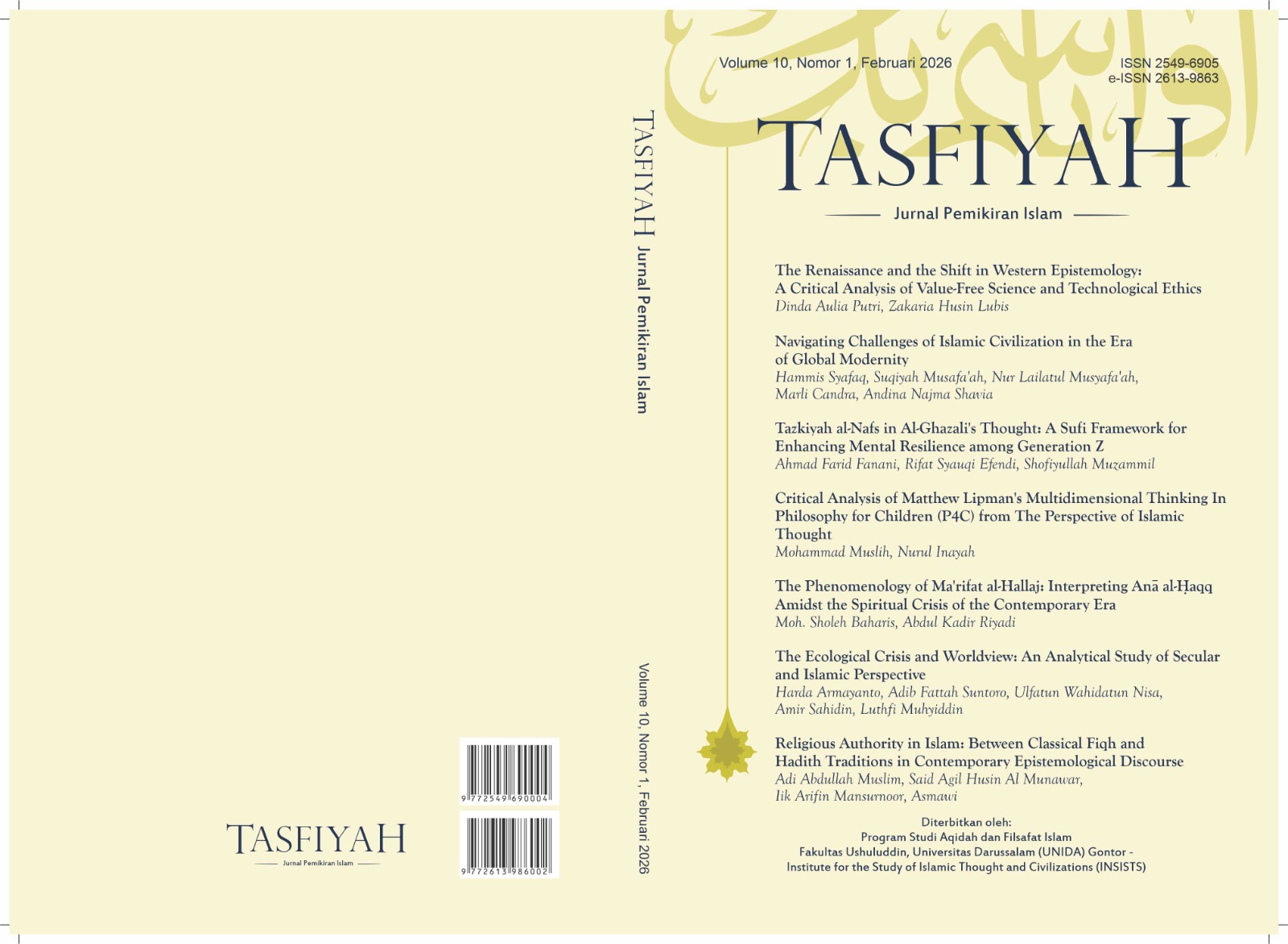
Religious Authority in Islam: Between Classical Fiqh and Hadith Traditions in Contemporary Epistemological Discourse
DOI:
https://doi.org/10.21111/tasfiyah.v10i1.32Keywords:
Religious Authority, Hadith Transmission, Fiqh Ijtihad, Diversity Paradigm, Socio-historical ApproachAbstract
This study aims to analyze the paradigm of religious authority in the historical context of the early generation of Islam through the relationship between hadith narration (periwayatan) and fiqh ijtihad. The formation of a religious paradigm requires a comprehensive understanding of religious texts by combining normative and historical approaches. However, in the development of Islamic intellectualism, academic problems arose regarding religious authority, particularly in the relationship between hadith narration and fiqh ijtihad in the generatian early Islam. The debate over the authority of hadith and methods of understanding religious texts gave rise to various religious paradigms that continue to be influential into the contemporary. This study uses a descriptive-analytical method with a socio-historical approach and type of research by literature study. Data were analyzed through a systematic depiction of the social, political, and intellectual dynamics that influenced the formation of religious authority in the early Islam. The results of the study indicate three main findings. First, the Qur'an and hadith are the highest authorities in Islam, understood through normative and historical approaches by scholars who possess scholarly authority and are recognized in the Islamic scholarly tradition, particularly in the discipline of hadith. Second, the debate on the authority of hadith has been ongoing since the time of the imams of the madhhab between ahl al-fiqh and ahl al-hadith, which was then synthesized by Imam al-Shafi'i and Imam Ibn Qutaybah, and continues into the contemporary era with the emergence of a tendency towards textualism in understanding hadith. Third, the formation of religious authority in the early Islamic period was influenced by political, social, and scholarly background factors, but scholarly factors most effective influence and benefit in building the legitimacy of authority in the public sphere. This research recommends the need for further study in early of Islamic history in more depth by tracing the genealogy of scholarship, politics, and theology in various Islamic intellectual centers, such as Kufa, Egypt, Syria, and Bukhara, in order to strengthen contemporary readings of the legacy of early Islamic scholarship.
References
‘Abd al-Mutallib, Rif’at Fauzi. Kutub al-Sunnah Dirāsatan Tauthīqīyyatan. Maktabah Khanji, 1978.
Abbott, Nabbia. Studies in Arabic Literary Papyri II Qur’anic Commentary and Tradition. Chicago: The University of Chicago, 1976.
Abdullah, Amin. Islamic Studies di Perguruan Tinggi: Pendekatan Integratif-Interkonektif. Yogyakarta: Pustaka Pelajar, 2006.
________. Studi Agama: Normativitas atau Historisitas?. Yogyakarta: Pustaka Pelajar, 1996.
Abu ‘Imarah, Mustafa. Adwā’ ‘alā Madaris al-Hadītsiyyah: al-Nash’ah wa al-Tatawwur. Kairo: Maktabah Iman, 2010.
Abu Daud. Sunan Abi Daud. Beirut: Dar Ibn Hazm Beirut, 1997.
Abu Zahw. The History of Hadith: Historiografi Hadits Nabi dari Masa ke Masa. Depok: Keira Publishing, 2015.
Al-’Asqalani, Ibn Hajar. Fatḥ al-Bārī bi Syarḥ Saḥīḥ al-Bukharī. Riyadh: Dar Tayyibah li al-Nashr wa al-Tauzi‘, 2005.
________. Syarḥ Nukhbah al-Fikr fī Muṣtalaḥāt Ahl al-Atsār. Karachi: Maktabah al-Bushra, 2011.
Al-A’zami, Muhammad Musthafa. Studies in Early Hadith Literature: With a Critical Edition of Some Early Texts. Chicago: Chicago: The University of Chicago Press, 1968.
Al-Baghdadi, al-Khatib. Al-Kifāyah fī Ma’rifat Uṣūl ’Ilm al-Riwāyah. Kairo: Dar al-Huda, 2003.
Al-Bukhari. al-Jami’ al-Sahīh. Kairo: al-Mathba’ah al-Salafiyah, 1400 H.
Al-Dahlawi, Shah Waliyullah. Syarh Tarājim Abwab Sahih al-Bukhari. Kairo: Dar al-Kitab al-Mishri, 1999.
Al-Hadid, Ibn Abi. Syarh Nahj al-Balāghah. Baghdad: Dar al-Kitab al-Gharby, 2007.
Al-Sawi, Salah. Al-Tsawābit wa al-Mutaghayyirāt fi Masirah al-‘Amal al-Islāmi al-Mu‘āṣir. Sharia Academy of Amrica, 2009.
Al-Syahrazuri, Utsman b. ‘Abd al-Raḥman. Ulūm al-Ḥadīts li Ibn al- Ṣalāḥ. Beirut: Dar al-Fikr al-Mu‘aṣir; Damaskus: Dar al-Fikr.
Al-Syaibani, Abu Abdullah Muhammad bin al-Hasan. Al-Jāmi’ al-Kabīr. Kairo: Lajnah Ihya’ al-Ma’arif al-Nu’maniyah. 1981.
Amin, Ahmad. Duḥā al-Islām. Kairo: Matba‘ah al-I‘timad, 1934.
Amin, Komaruddin. Menguji Kembali Keakuratan Metode Kritik Hadis. Jakarta: Hikmah, 2009.
Brown, Daniel. W. Rethinking Tradition in Modern Islamic Thought, vol. 5. Cambridge: Cambridge University Press, 1999.
Brown, Jonathan. The Canonization of al-Bukhari and Muslim: The Formation and Function of the Sunni Hadith Canon, vol. 69. Brill, 2007.
Coulson, Noel J. A History of Islamic Law. Edinburgh: Edinburgh University Press, 1978.
Crone, Patricia and M. Hinds, “God’s Caliph: Religious Authority in the First Centuries of Islam (Book Review),” Islamic Quarterly, vol. 34, no. 3, p. 200, 1990.
________. God’s Caliph: Religious Authority in the First Centuries of Islam. Cambridge: Cambridge University Press, 2003.
Al-Dārimī, Muqaddimah Sunan al-Dārimī, bāb fī faḍl al-‘Ilm wa al-‘Ulamā. Karachi: Qadīmi Kutub Khānah, 1407 H.
Dutton, Yasin. The Origin of Islamic Law: The Qur’an, the Muwatta’ and Madinan ‘Amal. New Delhi: Lawman Private Limited, 2000.
El Fadl, Khaled Abou. Atas Nama Tuhan: Dari Fikih Otoriter ke Fikih Otoritatif. Jakarta: Penerbit Serambi, 2004.
El Shamsy, Ahmad. The Canonization of Islamic Law: A Social and Intellectual History. University of Sussex Library, 2015.
Esack, Farid. Qur’an Liberation and Pluralism.
Fahl, Mahir Yasin. Ibrāz San’atu al-Ḥadīts fī Ṣahīh al-Bukhārī Wājib al-Waqti. Dar al-Anshar, 2014.
Hashim, Ahmad Umar. Qawā’id Uṣūl al-Ḥadīts. Beirut, 1984.
Hallaq, Wael B. Authority, Continuity and Change in Islamic Law. Cambridge University Press, 2004.
Hasbillah, Ahmad Ubaydi. Nalar Tekstual Ahli Hadis: Akar Formula Kultur Moderat Berbasis Tekstualisme. Ciputat: Maktabah Dar al-Sunnah, 2017.
Ibn Hanbal, Ahmad. Musnad al-Imām Aḥmad bin Hanbal, Muassasah al-Risālah, 1995.
Ibn al-Ṣalāḥ, ‘Ulūm al-Ḥadīts. Beirut: Dar al-Fikr al-Mua‘asir, 1986; Damaskus: Dar al-Fikr, 1986.
Ibn Hibban. Ṣaḥīḥ Ibn Hibban al-Musnad al-Ṣaḥīḥ ‘ala al-Taqāsim wa al-Anwā‘. Beirut: Dar Ibn Hazm, 2012. Di-taḥqīq oleh Muḥammad ‘Alī Sunimaz dan halis Ai Damīr.
Ibn Saʿd, Al-Tabaqāt al-Kubrā. Kairo: Maktabah al-Khanji, 2001.
Idri, Hadis dan Orientalis: Perspektif Ulama Hadis dan Orientalis Tentang Hadis Nabi. Depok: Kencana, 2008.
Itr, Nur al-Din. Manhaj al-Naqd fi ’Ulūm al-Ḥadīts. Damaskus: Dar al-Fikr, 1979.
Jamal, Ahmad Muhammad. Muftarayāt ‘ala al-Islām. Beirut: Dar al-‘Ilm li al-Malayin, 1987.
Kafi, Abu Bakr. Manhaj al-Imām al-Bukhārī fī Tasḥīḥ al-Aḥādits wa Ta’līlihā Min Khilāl al-Jāmi’ al- Ṣaḥīḥ. Dar Ibn Hazm.
Kadi, “Menjadi Wakil Tuhan Memahami Pemikiran Khaled Abou el Fadl tentang Konsep Otoritas Penafsir Pesan Tuhan,” Jurnal Ihkam, vol. 7, no. 1, 2012.
Kamali, Muhammad Hashim. Principles of Islamic Jurisprudence. Cambridge: The Islamic Texts Society, 2003.
Lucas, Scout C. “The Legal Principles of Muhammad b. Isma‘il al-Bukhari and Their Relationship to Classical Salafi Islam,” Islamic Law and Society, vol. 13, 2006.
Lucky, Nella. “Mendamaikan Logika ‘Normativitas’ dan ‘Historisitas’ dalam Studi Agama,” TOLERANSI: Media Ilmiah Komunikasi Umat Beragama, vol. 6, no. 1, pp. 123–132, 2014. DOI: http://dx.doi.org/10.24014/trs.v6i1.901
Mahmasaani, Sobhi. Falsafah al-Tasyrī’ fī al-Islām. Cc: Dar al-Kashshaf li al-Nashr wa al-Tiba‘ah wa al-Tauzi‘, 1952.
Mandaville, Peter. “Globalization and the politics of religious knowledge: Pluralizing authority in the Muslim world,” Theory Cult. Soc., vol. 24, no. 2, pp. 101–115, 2007. https://doi.org/10.1177/0263276407074998
Melchert, Christopher. “The Piety of the Hadith Folk,” Int. J. Middle East Stud., vol. 34, no. 3, pp. 425–439, 2002. DOI: https://doi.org/10.1017/S002074380200301X
Minhajuddin, Ikhtilaf Ulama dan Pengaruhnya terhadap Perkembangan Fiqh Islam. Jakarta: Disertasi Program Pascasarjana, IAIN Syarif Hidayatullah Jakarta, 2001.
al-Mizzi, Jamal al-Din Yusuf. Tahdzīb al-Kamāl fī Asmā al-Rijāl. Beirut: Mu’assasah al-Risalah, 1992.
Muna, Arif Chasanul. Wacana kritik Hadis-hadis Bernuansa Kekerasan terhadap Non-Muslim dalam Sahih al-Bukhari. Semarang: Disertasi UIN Waliisongo, 2019.
M. K. Munitz, “Contemporary Analytic Philosophy,” New York: Macmillan Publishing Co, INC, 1981.
Muslim, Adi Abdullah. Pengaruh Mazhab Ahl al-Ra’y dalam Kajian Hadis: Kajian Pemikiran Karya-karya Shaikh Abu Ghuddah. Tagerang Selatan: Young Progresive Muslim, 2016.
Al-Nasa’i, Sunan al-Imām al-Nasā’i. Riyadh: Maktabah al-Ma’arif li al-Nashr wa al-Tauzi‘, 1417 H.
al-Hajjaj, Muslim bin. “Sahih Muslim,” 1998, Bayt al-Afkar al-Dauliyah.
Pachoer, Rd. Datoek. A. “Sekularisasi dan Sekularisme Agama,” Religious: Jurnal Studi Agama-Agama Dan Lintas Budaya, vol. 1 No. 1, 2016.
Qudah, Sharaf Madrasah al- Ḥadīts fī al-Kūfah . Yordania: Kulliyah Shari’ah al-Jami’ah al-Urduniyah, 1980.
Rahman, Fazlur. Islamic Methodology in History. Islamabad: Islamic Research Institute Islamabad, 1995.
Schacht, Joseph. An Introduction to Islamic Law. Oxford: Clarendon Press, 1982.
________. The Origins of Muhammadan Jurisprudence. Oxford: Oxford University Press, 1950.
Shiddiqi, Muhammad Zubayr. Hadith Literature: Its Origin, Development & Special Features. Cambridge: The Islamic Texts Society, 1999.
Shihab, Quraish. Studi Kritis, Kata Pengantar.
Solomon, Robert. C. From Rationalism to Existentialism: The Existentialists and Their Nineteenth-Century Backgrounds. New York: Herper & Row, Publisher, 1972.
Stark, Rodney. “Secularization, RIP Sociology of Religion,” Sociol. Relig., vol. 60 No. (3), 1999.
Stodolsky, Volkan Yildiran. “A New Historical Model and Periodization for the Perception of the Sunnah of the Prophet and his Companions. Dissertation: Chicago Illinois, 2012.
Ṭaḥḥān, Mahmud.Taysīr Muṣṭalaḥ al-Ḥadīts. Iskandaria: Markaz al-Huda li al-Dirasat, 1415 H/1994.
Downloads
Submitted
Accepted
Published
How to Cite
Issue
Section
License
Copyright (c) 2026 Tasfiyah: Jurnal Pemikiran Islam

This work is licensed under a Creative Commons Attribution-NonCommercial-ShareAlike 4.0 International License.