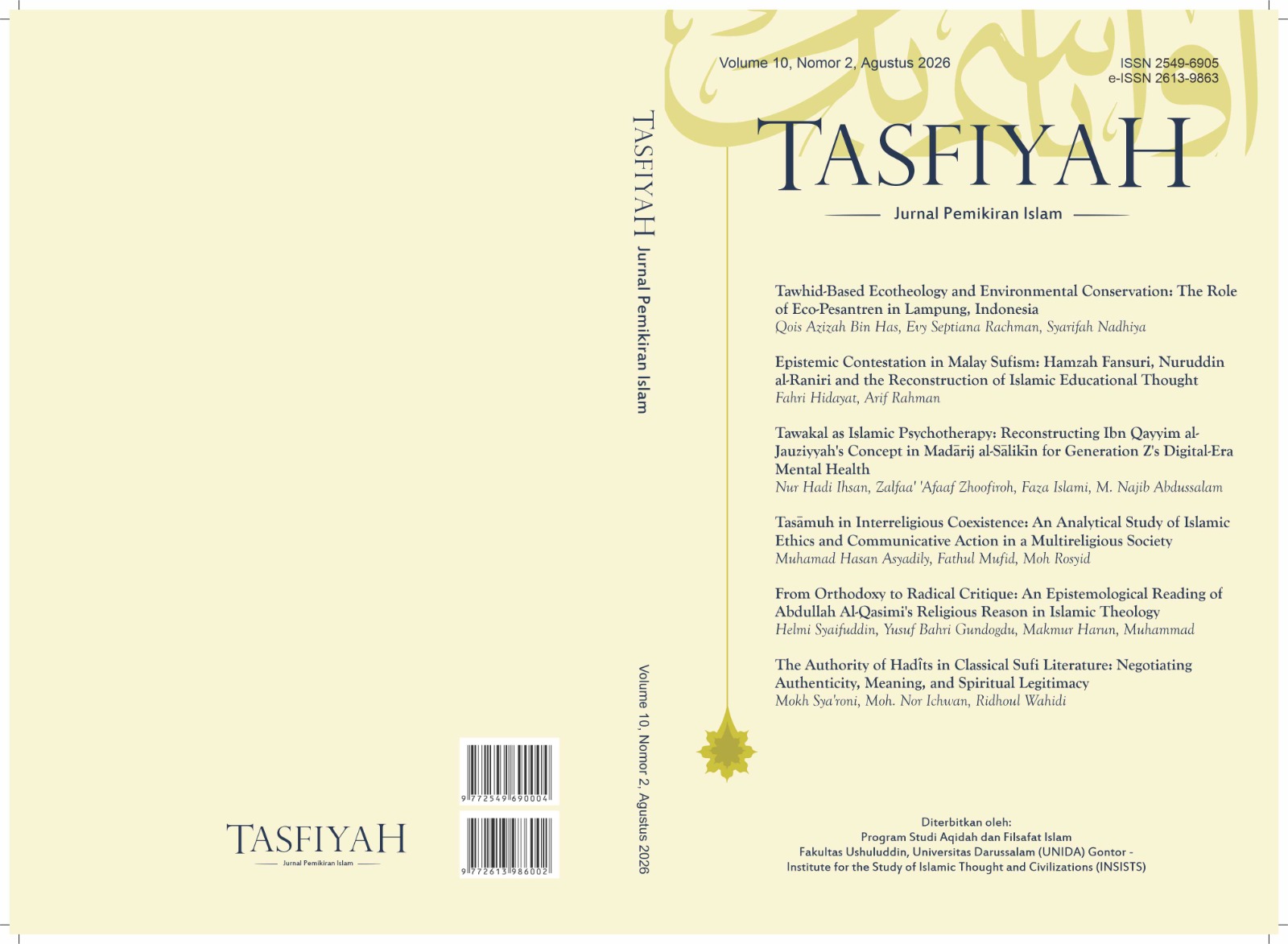
Tawhid-Based Ecotheology and Environmental Conservation: The Role of Eco-Pesantren in Lampung, Indonesia
DOI:
https://doi.org/10.21111/tasfiyah.v10i2.3Keywords:
Tawhid-Based Ecotheology, Environmental Conservation, Eco-Pesantren, Islamic Environmental Ethics, Ecological TransformationAbstract
This study aims to examine how tawhid-based ecotheological values are constructed, internalized, and translated into environmental conservation practices at Pesantren Ushuluddin and Pesantren Mathlaul Anwar in Lampung, Indonesia. The study adopts a qualitative approach using a multiple-case study design. Data were obtained through field observations, in-depth interviews with kiai and pesantren administrators, and analysis of relevant documents. A descriptive-interpretive analysis was employed to examine how theological principles shape environmental awareness and practices within the pesantren. The findings demonstrate that tawhid is understood beyond the theological affirmation of God’s oneness as an ecological worldview that establishes a relationship between God, human beings, and nature. This understanding is reflected in the principles of khalīfah, amānah, mīzān, maṣlaḥah, and the avoidance of isrāf and fasād. These theological values are cultivated through kiai leadership, religious learning, exemplary conduct, communal activities, and the pesantren’s hidden curriculum. Their internalization is reflected in various environmental initiatives, including waste management, tree planting, organic farming, green-space development, environmental cadre formation, student empowerment, and institutional collaboration. Based on these findings, the study recommends integrating tawhid-based ecotheology more systematically into pesantren education, institutional governance, environmental programs, and community empowerment. The study further develops a Transformative Tawhid-Based Eco-Pesantren Model comprising four interconnected stages: theological construction, value internalization, ecological actualization, and social transformation. The model offers a conceptual framework for strengthening environmentally oriented Islamic education by connecting theological commitment with concrete ecological responsibility.
References
Ahmad, Maghfur, ‘Three Sufi Communities Guarding the Earth: A Case Study of Mitigation and Adaptation to Climate Change in Indonesia’, Al-Jami’ah: Journal of Islamic Studies, 57.2 (2019), pp. 359–96, doi:10.14421/ajis.2019.572.359-396
Andi Rafida Ali Mursyid Azisi and Muhammad Jamaluddin, ‘ISLAM DAN EKOTEOLOGI (Telaah Terhadap Pesan Al-Qur’an untuk Menjaga Kearifan Lingkungan)’, Journal for Islamic Studies, 6.3 (2023)
Armayanto, Harda, and others, ‘The Ecological Crisis and Worldview: An Analytical Study of Secular and Islamic Perspective’, Tasfiyah: Jurnal Pemikiran Islam, 10.1 (2026), pp. 175–209, doi:10.21111/tasfiyah.v10i1.8
Bambang Irawan, ‘Islamic Boarding Schools (Pesantren), Sufism and Environmental Conservation Practices in Indonesia’, HTS Teologiese Studies/Theological Studies 78(4), A7073, published online 2022, doi:https://doi. org/10.4102/hts.v78i4.7073
Fachruddin Majeri Mangunjaya, Ekopesantren: Bagaimana Merancang Pesantren Ramah Lingkungan? (Yayasan Pustaka Obor Indonesia, n.d.)
Fanani, Muhyar, and Florian Pohl, ‘Fiqh-Based Social Transformation in Farmer Empowerment: A Participatory Action Research Approach’, Al-Jami’ah: Journal of Islamic Studies, 62.2 (2024), pp. 305–35, doi:10.14421/ajis.2024.622.305-335
Fatoni, Ahmad, AL-AFKAR : Journal for Islamic Studies Islam Dan Lingkungan Hidup, 7.2 (2024), pp. 320–31, doi:10.31943/afkarjournal.v7i2.1123.Islam
Fikri Mahzumi, S.Hum., M.Fil.I, ‘Kalam Rimba (Ekoteologi Transformatif Di Pesantren Walisongo Tuban)’, THE 16th ANNUAL INTERNATIONAL CONFERENCE ON ISLAMIC STUDIES (AICIS)
Fua, Jumardin La, and others, ‘Islamic Education on Formation of Environmental Awareness in Pondok Pesantren Indonesia’, IOP Conference Series: Earth and Environmental Science, 156 (2018), p. 012035, doi:10.1088/1755-1315/156/1/012035
Herdiansyah, Herdis, Hadid Sukmana, and Ratih Lestarini, ‘Eco-Pesantren as A Basic Forming of Environmental Moral and Theology’, KALAM, 12.2 (2019), pp. 303–26, doi:10.24042/klm.v12i2.2834
Karim, Abdul, ‘Integration of Religious Awareness in Environmental Education’, QIJIS (Qudus International Journal of Islamic Studies), 10.2 (2022), p. 415, doi:10.21043/qijis.v10i2.14404
Lembaga Ilmu Pengetahuan Indonesia, ‘Kekinian Keanekaragaman Hayati Indonesia.’, LIPI, 2014
Lynn White, ‘Religious Ethics and Environmental Problems’, The Journal of Religious Ethics, 37.2 (n.d.), pp. 283–309
——, ‘The Historical Roots of Our Ecologic Crisis’, American Association for the Advancement of Science, 155.3767 (n.d.)
Maslani, ‘Eco-Theology: Islamic Ethics and Environmental Transformation in Islamic Boarding Schools’, Edukasi Islam, 12.04 (2023)
Mochammad Mizwar S, ‘Eco-Pesantren: Analisis Pemahaman Teologi Lingkungan Di Pondok Pesantren Al-Ittifaq’, Gunung Djati Conference Series, 24 (2023)
Moh. Ahsan S. Mandra, Rusli Ismail, ‘Eco-Pesantren Implementation Strategy Supports the Environmental Behavior of Islamic Boarding School Students in South Sulawesi’, Atlantis Press SARL., Advances in Social Science, Education and Humanities Research 654 (2022), p. 28
Nurulloh, Endang Syarif, ‘Pendidikan Islam dan Pengembangan Kesadaran Lingkungan’, Jurnal Penelitian Pendidikan Islam, 7.2 (2019), p. 237, doi:10.36667/jppi.v7i2.366
Saputra, Ahmad Said, and Muhammad Zulham, Implementasi Program Ekopesantren dalam Mewujudkan Pondok Pesantren Ramah Lingkungan (Studi kasus: Pondok Pesantren Salafiyah Darunnajah Braja Selebah, Lampung), 8.1 (2024)
Sari Tri Anjani and Fachruddin M. Mangunjaya, Ekopesantren Sebagai Pemberdayaan Komunitas Pesantren Dalam Menjaga Dan Melestarikan Lingkungan (Studi Kasus: Pondok Pesantren Daar El-Istiqomah Kampus 2, Serang, Banten), 8.1 (2024)
Sazali, Munawir, ‘PESANTREN DAN KONSERVASI LINGKUNGAN (STUDI KASUS DI PONDOK PESANTREN DARUMUHYIDDIN NW DEBOK LOMBOK TIMUR)’, PALAPA, Jurnal Studi Keislaman Dan Kependidikan, 11.1 (2023), pp. 568–91
Seyyed Hossain Nasr, Religion and the Order of Nature (Oxford University Press, 1996)
Siti Zulaikha, ‘Elestarian Lingkungan Hidup Perspektif Hukum Islam Dan Undang-Undang’, AKADEMIKA: Jurnal Pemikiran Islam, 19.2 (2014), p. 243
Subaidi, and others, ‘Eco-Pesantren: Islamic Education in Forest Conservation Landscapes’, Fudan Journal of the Humanities and Social Sciences, 16.4 (2023), pp. 541–67, doi:10.1007/s40647-023-00386-w.
Downloads
Submitted
Accepted
Published
How to Cite
Issue
Section
License
Copyright (c) 2026 Tasfiyah: Jurnal Pemikiran Islam

This work is licensed under a Creative Commons Attribution-NonCommercial-ShareAlike 4.0 International License.